Imaginif prompts for daily writers.
If you wish to join the Writers Prompt Daily simply use the below photo (changes daily) as a prompt and post a short story, poem or paragraph to your blog. Leave a comment and your link here so that all participants can come to you and read/comment/encourage. Stories below are copyright and are Megan Bayliss' writing around the below daily picture prompt.


Showing posts with label children. Show all posts

Kidnapping. Saying "NO," is Child Protection.

I saved my little brother from kidnapping when I was just seven years old. I don't know why I saved him because I hated him and I wished to send him away. He was a three-year-old pest! He’d get into my bedroom when I was at school, pull out my toys, tear my books and touch my jewellery.

To this very day, I tell my brother he owes me for rescuing him. My other brothers and sister tell me not to be so mean but if I don't stay mean he might think an alien has stolen the real me. He is used to me picking on him but... he is also used to me sticking up for him when things are going wrong. How to stick up for him is something I did without thinking on the day the kidnapper tried to steal him.

It was a very hot day and all of the families in the barracks where we lived were having picnics at the pool. Everyone was busy - swimming, eating, watching diving competitions, judging splashes. My Mum had five kids to watch so we older kids had to help with the little ones. I so didn't want to watch Drew but Mum told me that all big sisters had to suffer little brothers and that I would be sad if ever anything happened to him.

Mum gave me some money and asked me to run across to the shop to buy some ice-blocks. I was excited. She trusted me with the money AND to go to the shop alone. "Take Drew with you," she said.

"Bum! I hate him. He's a pest."

Mum gave me a look of "don't make me punish you in public".

In his usual pest like state, Drew ran ahead of me down the windy path that led to the far-away road we had to cross. Hidden from view from both the pool and the road the path wound its way through beautiful tropical gardens. The gardens were a jungle. The plants were so close together that a dog would have had a hard time trying to get in for a pee. The winding path and the magical jungle made it impossible to see too far ahead. We had no idea what was around the next bend and we loved it. It was a treasure waiting to be found.

Drew ran ahead of me and I lost sight of him. A pest he may have been but I was worried because I couldn't see him. It didn't matter how much he destroyed my belongings he was my little brother, my family and I wanted him to be safe.

I started to run so that I could catch him before he got to the road. What would happen if he ran straight into the cars? My tummy felt all jumbly, like I had a big snake squirming around in there.

I couldn't hear him. No running footsteps, no singing; nothing. As I rounded a bend in the shadowed path, I came upon a man I had never seen. He had Drew by the hand and was pulling him into the jungle. Without even thinking about it, I grabbed Drew by the other hand and started a tug-of-war.

I don't know where my words came from; they just fell out of my mouth without any planning.

"Where are you taking my brother?"

"We're going for a drive because it's too hot for running."

"My Mum would say no. We are swimming and going to eat ice-blocks." The tug-a-war kept happening.

"I know your Dad. He asked me to come and take you for a drive." The man was in army uniform and we were at the army swimming pool. My Dad was the army boss so it could be true.

"No." I knew it wasn’t true. "Give him back to me. He isn't going anywhere. He is my brother. Give him to me."

The man in army uniform tried to trick me, "Your father said I have to take him. Father is waiting."

Somehow, and I don't know how, my thoughts were clear. My body was scared. My knees were shaking and my arms were tired of pulling. My poor little legs were jelly. The muscles were working hard to keep my footing and balance. My thoughts though, were clear. I knew that this man was phony. No soldier that I knew would have a prickly face, dare to walk around in an un-ironed uniform or without his hat and proper boots. This man had stolen the uniform and he was BAD.

I prayed to God, "Please help me. I'm not strong enough to save my brother."

I gave one big pull and said, "We'll just go back and ask Mum is it okay then."

The man let go. Drew flew back into me and knocked me over. The man disappeared. He melted into the jungle and I couldn't see him anywhere.

I hugged Drew, and we RAN back to Mum. I started crying and I couldn't talk. My body was shaking all over and I had to sit down. Drew came and snuggled into me and patted my hand.

"Take a deep breath," Mum coached me. "Tell me what happened."

People gathered around. Everyone wanted to help. I told the crowd that a man tried to steal Drew. The man was in Army uniform and had a little beard. He had black skin, red socks, and shoes that didn't belong with his army uniform.

Well, the army dads there ran down the path and began their manhunt. Nobody was going to hurt children and get away with it. They never caught the man though – he was long gone.

Drew and I became friends (I always had to look after him after that!). I learnt that he wasn’t too bad and that my memory was good. Even when I’m scared, I now know that my mind can remain strong, that my eyes see important things and that my brain will remember.


Could your child say "no"? What do you do to practice saying "no?" Tomorrow I'll give you some parent tips on helping your child to say "no."


Related article on the protective behaviour step of, Say No: BITSS of Say No.


Photo (Tug O' War) courtesy of KevinKLuu at stock.xchng

Topical Whensday: When will children be visible?

UNICEF’s 2006 report on the State of the World's Children focuses on excluded and invisible children who have no access to essential services, protection and participation. The sad reality of many of the world’s children set me reflecting upon the visibility of children in my own town.

To walk into my house, there would be little doubt that children are a focus: that they are valued and highly visible. To walk down my street, many houses wear children’s toys as a sign of “Children live here.” My local shopping village however, does not make children visible. A trendy little spot, I was unable to find a single sign that suggested visibility of children, let only being a child friendly place.

Some months ago, I facilitated a Child Protection forum in a beautiful holiday spot called Port Douglas. A place of stunning natural beauty, diversity, and a playground for the rich and famous, local people were concerned about the hidden child protection issues. Proactive and dedicated, they looked for a way to raise the profile of their most precious resource: the town’s children.

One young psychologist aptly raised the question: Where are our children? A drive around the beautiful town confirmed for me that Port Douglas offered few external signs of being child friendly. It was almost as though children were invisible to visitors. While this does not mean that the children were being hidden, or abused, it reflects a value that children are not as important as the tourist dollar.

The more I have remained conscious of the external signs of community friendliness toward children, the more I have noticed that the friendliness occurs in pockets. It is almost as though business, development and tourism reject children unless there is a financial gain in catering to the needs of children.

Our children are not a commodity to be bought and sold. Our children are a more important natural resource than oil, water, gas or eco tourism. Our children are our sustainable future and have a leading role in helping us manage the other mentioned natural resources that are becoming endangered. We need our children. We need to protect them, to make them visible, to give them a voice.

Look around your community. What are the signs you see that make children visible? Are there well-serviced parks with trees and playground equipment? Children’s artwork proudly displayed on the sides of buses? Stores that cater for families with young children? Interactive display’s that help children retain new knowledge? The list is endless.

When will children be visible in our developed worlds: When we start looking for the signs of a child friendly community and take action to replace child unfriendliness with the high profile of children’s needs.

Other Topical Whensday blogs by Megan Bayliss:

Topical Whensday: When Will YOU Tee On to Cause an Effect?

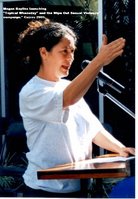
Topical Whensday: When will YOU wear a Colored Tee to Recognize Violence Against Women and Children.

The business of protecting children.

Child protection is a community responsibility. Statutory bodies (aka "the welfare")are the pointy end of the stick. They come in after an act of child abuse occurs. The ideal situation is not to need child protection statutory bodies. If all community members took responsibility for placing child protection high on the daily agenda we may just reach the place of under working our child protection workers.

NAPCAN Australia works to encourage child friendly practice. They set challenges for individuals, communities and businesses. Eager to protect all kids and reduce the staggering claim that a child in Australia is abused every 13 minutes, I support their endeavors and loan them my full commitment.

Child friendly practice is, unbelievably, an area that many parents have told me they do not have time for. They wrongly think that they have to become radical, vocal and give up their day jobs. Child friendly practice is something we can all do without changing our lives or going back to University to learn theories, skills and mind twisting histories. Child friendly practice is an attitude that many already display without realizing what they are doing. Child friendly practice helps keep kids safe.

NAPCAN’s Child friendly Challenge for INDIVIDUALS advocates the following simple tips that EVERYONE can do easily and quickly:

1. Smile at a child - you were a child once

2. Let a parent with kids ahead of you in the queue

3. Donate your clothing, furniture or toys for use by another family

4. Cook a meal for parents with a newborn baby

5. Tell a child a story from your childhood

How easy is that? Take the Child Friendly Challenge today and let kids know that their business is our business because kids count.

Have you got any other simple child friendly tips that people can do to help protect kids?

Imaginif…You Knew How BITSS of Protective Behaviors Began.

After 15 years of working with families and children in both Australia and the U.K, across all levels of Government and in the community and private sectors, Megan Bayliss was sick and tired of waiting for business to make protective behaviors their business.

Megan embarked on a family focused business path of resource development. The original idea was to create and make available a number of specific resources that were easy to obtain, affordable and met best practice guidelines for working with children. Throughout this journey, market research continually supported that workers and parents were unable to identify specific elements of any protective behaviour programs.

With this low-level community knowledge in mind, Megan began to develop a model that would make it easy for parents, and workers, to remember how to fit protective behaviours together. Hence, a family friendly model of protective play resulted in the BITSS model of Protective Behaviors. BITSS is an easy to remember acronym for the important protective behaviour building blocks that are common to all other programs: the BITSS to remember are – Body ownership, Intuition, Touch, Say no, Support network. Since development, the model has grown to include in home protective play tutorials for parents/grandparents, easy read tutorials to support protective play, a series of children’s chapter books and workshops for people working with families and children.

How do you teach protective behaviors to your children?

What does your business do to support ending child abuse?

Welcome. Imaginif…you knew who we were.

Hello. Come on in and have a virtual coffee with us.

Imaginif is a privately owned Protective Behavior company that aims not only to protect children from abuse but also to give a voice to those who have survived child abuse.

There are three of us posting blogs around the business of protective behaviors: Megan Bayliss, Paul Martin and Jade Pinto. We each have a different area of professional expertise in the area of preventing child abuse and we each have an active part to play in making child protection important business.

Talking about child abuse is scary. The topic remains hidden under the covers and many parents prefer not to raise it with their children because of a fear they will damage their children’s innocence.

We want YOU. We want parents, grandparents, aunts, uncles, the business sector, and the survivors to help give a global voice to ending child abuse.

Child abuse is BIG business and big business needs big leaders willing to make child abuse prevention a BIG priority. YOU are that big leader.

Join us daily for a coffee and a chat. Share you stories, your ideas, your passion and most importantly, your POWER. Help us positively market the strength and vision that many survivors of child abuse have as their gift.

Blow the cover on child abuse. Talk, talk, talk and show the business community how beneficial it will be for them to support ending child abuse.

Imaginif means business. Protecting against child abuse is our business.

 
powered by Blogger