Imaginif prompts for daily writers.
If you wish to join the Writers Prompt Daily simply use the below photo (changes daily) as a prompt and post a short story, poem or paragraph to your blog. Leave a comment and your link here so that all participants can come to you and read/comment/encourage. Stories below are copyright and are Megan Bayliss' writing around the below daily picture prompt.


Showing posts with label protective behaviours. Show all posts

Can We Stop Child Sexual Abuse?

Child sexual abuse is still not a topic discussed enough in family homes. Just as the dynamics of sexual abuse are shrouded in secrecy and manipulation, so too are many family conversations: particularly conversations around sexual abuse prevention. Parents often state they are scared of spoiling their children's innocence, scarring their kids or they don't see why they should talk about it because their kids are safe.

Child sexual abusers will take away your child's innocence. Children who know nothing of protective behaviours and the manipulating tactics of predators often are unaware that they are allowed to talk to their protective parents when and if something abusive happens. Scared and confused once something has happened, children who grow up in homes where sexual abuse prevention is not talked about may wrongly assume that abuse is a taboo subject. Perpetrators love this. Not talking about protection and prevention may make our kids fair game for perverts and manipulators. No child is safe from the threat of terrorism - including domestic terrorism.

Eighty five percent of reported child sexual abuse is perpetrated by somebody well known to the child: somebody that access our children on a regular basis and is welcomed into our safe homes and daily lives. Child protection is serious business and serious, good parents talk about serious and scary stuff because they know their children may be a risk from people they trust and love.

A new site has caught my attention: Teacher Smackdown. On the site, abusive teachers are named: those very people charged with protecting and encouraging our vulnerable children. To quote from the site: Anne-Marie Nichols is a 40-something award winning blogger, freelance copywriter, and WAHM to two young school age children. As a founding board member of a Colorado public charter school, she knows that most teachers are dedicated, hardworking professionals. Yet bad teachers exist, betraying the public trust one kid at a time. These are their stories.

Thank you Anne-Marie. You are providing a Protective Behaviour communication service that I hope parents will appreciate and learn from. Your post, Teaching Children About Sexual Abuse, is excellent and based in best practice. I encourage parents, everywhere, to read it.

Can we stop child sexual abuse? We can't because we are not responsible for the perpetrations: the sexual predators are. We can though, educate and protect our children by ensuring they know that sex is not a taboo subject and that some people use sex and touching in very bad ways. If a child is sexually abused it is NEVER their fault. Children need to know this prior to anything ever happening to them. Knowing you are not responsible makes it easier to go and tell someone about the bad stuff that has just happened.

Together we can impact upon the lower risk of our children being sexually abused. We can talk, we can educate, we can place the blame firmly where it belongs: on the shoulders of the sexual predators that trick us and our children into thinking that bad behaviours are acceptable.

If you have been sexually abused, it is not your fault. Please, go and talk to someone. Help us to break the vicious cycle of secrecy and in doing so, help protect all children.

For those interested in joining the call of safe communities with a zero tolerance to sexual crimes consider raising a blog about your thoughts, ideas, aspirations, experiences or even messages to predators. Held on April 5, 2007, Blog Against Sexual Violence day will be a force to be reckoned with. Proudly wear the available banner on your site. Together we will impact upon keeping our kids safe from sexual predators: no matter who or where they are.


Blog Against Sexual Violence logo

Australia Day to Look Out for your Mate

Tomorrow, Friday January 26 2007, is Australia Day. We Aussies celebrate the day as a public holiday, have barbeques, go to the beach, watch or participate in sporting events or gather with family and mates and eat meat pies, lamingtons and pavlova. Australia is so much more than Meat Pies, great beaches and Kangaroos though. Australia is all about protecting our environment: including the environment of people.

On January 26, 1788 Captain Arthur Phillip took formal possession of the colony of New South Wales and became its first Governor. This day flagged the foundation day of the new colony, the new world, Australia.

Australia is a harsh land. The cruel sun and elements have made Aussies tough, survivors, resourceful and tenacious. Our isolation led to ingenuity and leadership. Although quick to cut down those Aussies that we consider, “tall poppies” we also pride ourselves on the concept of being a "true blue" mate.

Mateship is integral to the Aussie way of life. We look out for our mates and give them a hand when required. Is this the reason then that Australians have adopted, adapted and take seriously protective behaviours? We want to protect our mates.

Although the original protective behaviour program dealt specifically with child sexual abuse, Australia is responsible for widening the program to ensure that we look out for all community members needing protection from any element of harm. The Aussie way of life co-exists in many risk-taking situations: the beach with its sharks, crocodiles or surf, the outback with its snakes and spiders, the gum treed bush with its propensity to flood, drought and bush fire, and the cities with its pull of escaping to the wild colonial landscape. Add to this crime, fear of crime and the lessons we have learnt from other densely populated countries and my view is that Australia has got it right with their all encompassing protective behaviour programs and their views of looking out for our mates.

Happy Australia Day mate. How about tomorrow you help us celebrate by enacting our mate ship values. Look out for the people in your neighbourhood, apartment block or family. Engage in some protective behaviours and help keep the world’s children safe. Lend a child a hand, a smile, ring the authorities about that public playground equipment that needs fixing, report child abuse if you suspect it is happening.

Imaginif is about to launch the world’s biggest on-line child protection conversation and we hope that you will join us. The more mates we have, the quicker the world will understand that child protection IS serious business.

Some other blogs about Australia Day if you’re interested:

G’day Mate. Australia Day, true blue!
A nation of bonzer cringers?
Australia Day 2007
Google vs Microsoft on Australia Day
Australia Week. G’day LA and NY
Best vacation destinations
The story of a great Australian woman.

Water Safety.

While an Aussie Diver has survived an attack by the most savage predator in the world, our children may not be so lucky.

Child Safety and Protective Behaviours are not just about teaching personal safety from sexual predators, it is helping our children stay safe in all situations.

Water safety is important. The Queensland Government reports on drowning trends and states that:

  • Child drownings in Queensland swimming pools accounts for one quarter of all paediatric injury deaths and is the most common cause of traumatic death for children aged one to four years.

  • Approximately half of all drownings involving children under five years occurred in residential swimming pools. (Between 1992 and 2001, 73 children aged under five years died as a result of drowning in residential swimming pools in Queensland).

  • For every child drowning, up to 14 children are taken to hospital emergency departments, and four are admitted to hospital.

  • One study has found that 6 - 7% of these children will develop neurological deficits and will be permanently disabled or die as a consequence of nearly drowning.

  • It is also estimated that for every child taken to hospital emergency departments, there are 10 'near misses' (ie. children suffering immersion who are quickly rescued).

The National Centre for Injury Prevention and Control stresses that:

  • In 2003, there were 3,306 unintentional fatal drownings in the United States, averaging nine people per day. This figure does not include drownings in boating-related incidents (CDC 2005).

  • For every child 14 years and younger who dies from drowning, five receive emergency department care for nonfatal submersion injuries. More than half of these children require hospitalization (CDC 2005). Nonfatal drownings can cause brain damage that result in long-term disabilities ranging from memory problems and learning disabilities to the permanent loss of basic functioning (i.e., permanent vegetative state).

In our corner of the globe, water safety equates to protection against oceanic predators: sharks, crocodiles and dangerous creatures like Box Jellyfish or Stone Fish. While Steve Irwin and the Wildlife Warriors have done an amazing job at raising awareness around the wonders and conservation of these dangerous creatures, they have also hammered home the importance of respect and care of the individual when trying to view these animals in their natural habitat. This was Steve’s contribution to protective behaviour water safety.

For the vast majority of families, water safety translates to keeping your kids safe in the pool or at the beach. In the pool, don’t forget to Do the Five and keep our kids alive:

1. Fence the Pool
2. Shut the Gate
3. Teach Your Kids to Swim
4. Supervise
5. Learn Resuscitation

At the seaside, always swim between the flags on patrolled beaches:
F. Find the flags and swim between them.
L. Look at the safety signs.
A. Ask a Lifesaver for advise.
G. Grab a friend to swim with you.
S. Stick your hand up for help.

Most parents already do this. Highly aware of the dangers of drowning, millions of warrior parents enact protective behaviour water safety on a daily basis. Parents like these deserve celebrating. As parents, we don’t get enough pats on the back for keeping our kids safe. Let’s start a conversation and support each other. By celebrating what we already do to keep kids safe, we encourage other parents to learn, practice and keep their kids safe from drowning or predator attack too.

How do you teach your children the importance of water safety?

Sun Safety

Protective Behaviours are about protecting children and adults from all elements of danger. Water, Sun, Poison and Personal safety lie high on the agendas of some Protective Behaviour programs.

Complacency lies high on the agendas of some parents. Receiving rebuffs about the work we do is common ground for workers attempting to protect children from sexual assault. Many parents seem to think there is no need to talk about personal safety with their children. Safe in their own families, parents become complacent and do not risk manage around protective behaviours.

I am no different. My children have grown up with the fear around yet another of my boring comments: Sunburn is sun damage. The Slip, Slap, Slop program has been instilled into my children from its day of inception. Yet still, I became complacent and yesterday I allowed my body to be abused by the cruel tropical sun. Boy and partner were fine. They spent the entire day snorkeling on the Great Barrier Reef, protected by sun and stinger suits with regular slatherings of SPF 30+ sun screen.

While rubbing moisturizer into my burnt body, partner suggested that it was irresponsible for a protective behaviour consultant to allow sun abuse. I agree. I failed and today I am hurting. I will heal though and I pray that I haven’t allowed melanoma to invade my protected space.

None of us can afford to become complacent around personal safety. Our children may well be safe with us but it takes only one other person to zero in on our child, to sexually abuse them, for a life time of hurt, confusion and betrayal to stay embedded in the hearts and minds of our child.

Protective Behaviours in the sun is very important. As you place a hat or sun screen on your child, spare a thought for how you are going to protect your child from the cancer of child sexual abuse. If you’re looking for some simple play ideas of how to protectively play, visit Toys, Books and Games Protect Kids.

Related Great Barrier Reef marine species articles by an 11 year old home school boy (my son):
Turtle Facts.
Starfish are Echinoderms

Protect Kids from Sexual Predators. Use Correct Names for Private Parts.

Correct names for body parts is important in the fight against child sexual abuse. Many parents appear to have fear around calling a vagina a vagina and an anus an anus. Instead they make up “cute" names: box, willy, peach, whistle, etc.

Predators know this and they also use “cute" names to trick the child into accommodating bad touch by making the touch appear cute and normal.

An adult woman, sexually abused as a child, always viewed Boxing Day as the worse day of the year. Although subjected to non-penetrative sexual abuse for some time, Boxing Day changed it for her.

The incestuous perpetrator suggested that he put something in her “box”, that Boxing Day was particularly for that. Already groomed to accept that her Vagina was a “box” and sanctioned by a day that was named after the specialness of little girls, the child was raped on Boxing Day. It took her a long time to learn that Boxing Day was about something different and that other little girls didn't get the same treatement on that day, or any other day.

Had this child known correct terminology she may have known that the predator was tricking her. In the subsequent court case, her case may have been won if words and actions had not been confused, manipulated and supported by fact that it was indeed Boxing Day on the day of alleged rape and that the child had somehow imagined that Boxing Day was about her box.

We don’t call an arm something different. Call a vagina a vagina and a penis a penis because that is what they are. Ignorance is not innocence. By giving our children the correct information we are protecting them, not spoiling their innocence. It is the perpetrators who will often use a child's ignorance and rob them of their innocence.

For some protective play ideas on how to introduce using correct terminology for private body parts, check out Private Parts: What to Call Them?

For a lovely story written by another parenting blogger have a look at Private Parts by Booby Juice.

Child Protection Billboard Funded by Celebrity Purses.

Signs warning parents of sexual predators have swum around my head all night. Yesterday’s successful Crocodile warnings have made a positive impact on me. Thinking further through the issue, I decided that creating fear in parents trying to protect their children from sexual predators is disempowering. Positive, non-fear based campaigns are empowering and can be owned by a greater part of any community.

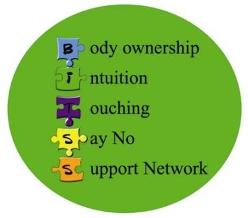
To have a roadside billboard, positively displaying the elements of a Protective Behaviour program may act as a constant visual reminder of what to do to keep kids safe. The billboard could positively remind parents to put a hat and sun screen on their child, swim between the flags, wear seatbelts, look before crossing the road, keep poisons out of reach and clearly state the tenets of the BITSS model of personal safety: Body Ownership, Intuition, Touch, Say No and Support Network.

Billboards reach millions of motorists on a daily basis. Effective but expensive advertising that is way outside of my meager budget. How to achieve such a large scale, community focused and positive protective behaviour campaign???

Purse for a Curse © Megan Bayliss 2006 is an idea I had some months ago. We were discussing the value of Shave for a Cure and the phrase and idea just popped into my head. Partner (a business consultant) loved “Purse for a Curse” immediately. It is catchy, focused and could fundraise for several social curse areas: child sexual abuse, homelessness, domestic violence, poverty, environmental causes, etc.

The idea born to me overnight is to hold an auction of celebrity donated and unique purses, bags or wallets. Monies raised from the auction would then fund a Protective Behaviour roadside billboard, spreading a protective message to as many people as possible.

What do readers think of the idea? Would this work in your community? How would you react to a Protective Behaviour billboard? Does anyone have a personal relationship with Oprah Winfrey? I would love her to donate a handbag or purse to kick off “Purse for a Curse”.

Child Protection: A Job that Never Ends

The time of house protection for my adult children is upon us. Today we are off to Ingham to housesit for my son and daughter-in-law while they have a well-deserved break at Airlie Beach. We will not be back until Christmas Eve.

Child protection is a job that never ends. My son is 22 and I know I am going to do the whole mother thing as he and his wife drive away: drive safely, risk manage around situations, don’t walk alone, ring me if anything goes wrong.

While parental concern drives kids to distraction, parental concern also provides reminders that we all need to stay vigilant in every situation. Just as fences, windows, doors, walls and roof protect our house, it is a parents job to act protectively toward their children.

Children growing up in incestuous situations often do not have a parent looking out for their holistic welfare. The lies and manipulation required to keep child sexual abuse, or incest, a secret damage our children’s minds and create a confused dynamic of trust.

Hypervigilant through fear of being hurt, the child who has been sexually assaulted often scans the environment for danger but misses the danger when it pops up right under their nose. These are the children who could well benefit from constant, daily reminders that often bad things happen when we least expect them and that they often happen in what we may consider to be safe spaces.

When was the last time that you provided your child with safety reminders? Most parents engage in protective behaviours without even realising that they are doing it. Given that child sexual abuse is so prevalent it is time to make a conscious decision to do our utmost to keep ALL kids safe.

Do a protective behaviour audit. What words, games or messages do you give to your children to let them know that they can tell you about anything, that they can listen to their early warning signs and that it is okay to be rude to people and say no when other people are breaking the rules of protection, decency and appropriateness.

See you again on Christmas Eve. Stay safe and remember that nothing is so awful that you can’t talk to someone about it.


Related articles on the BITSS model of Protective Behaviours:


What are Protective Behaviors?


Protective Behaviors are a set of sensible, down to earth behavioral response plans for personal safety. Protective Behaviors can cover personal safety in all sorts of situations: sun, road, water, poison, health, farm, fire and people safety. Learning about Protective Behaviors is a way of developing “how to respond” information and personal power. Protective Behaviors give people the skills they need to protect themselves from harm. Often used to protect children from sexual predators, Protective Behavior programs also empower the elderly, the sick, and buildings like schools or churches that are sometimes a target for vandalism.

Most people use Protective Behaviors with children without realizing they are even doing it. Every time you put hat and shoes on a child, you are protecting them from sun and ground harm. Every time you tell a child not to get into a car with someone they do not know, you are beginning to protect that child. Every time you speak to your child about good touch/bad touch, you are helping to empower your child to know what to do if someone tries to touch them inappropriately.

Although there are many different ways to empower people to protect themselves, the most well known program in the world is The Protective Behavior Program. Designed in 1984 by American Social Worker, Peg Floundreu West, the program is widely used across the U.S.A, Australia and in the U.K.

The concepts, ideas, and strategies of the original Protective Behaviour Program are themed to help us all remember that:

1. We all have the right to feel safe all of the time, and

2. Nothing is so awful we can't talk to someone about it.

These two themes guide lesson plans around keeping yourself safe from harm. Although the Protective Behavior Program originally focused on protecting children from sexual abuse, the two themes now encompass community safety in a range of different settings and for a range of different safety needs.

Australian Social Worker, Megan Bayliss, designed another widely accepted personal safety program: the BITSS model of Protective Behaviors. The model deals only with protecting against sexual abuse and focuses on protective play around,

B Body Ownership

I Intuition

T Touch

S Say No

S Support Network.

The central tenet of the BITSS model is to capture teachable moments during everyday play. It is not a classroom based program, rather, parents are encouraged to learn how to use everyday play resources to act as triggers for protective learning and practice around each of the BITSS elements.

Protective Behaviors help to keep our children safe. However, it is not a child’s responsibility to prevent child abuse. The responsibility lies with the abuser. If a child is sexually abused after receiving training in protective behaviors, it is not their fault nor does it mean the child did not learn anything. Sexual Abuse is always the fault of the predator.

Help keep our children safe. Teach some protective behaviors today and act protectively by telling someone if you suspect abuse of a child.


What's happening in your town at the moment to help protect our most valuable and sustainable resource: our children?


Which businessses are showing the most support? Let us know so that we can support them too.

Imaginif…You Knew How BITSS of Protective Behaviors Began.

After 15 years of working with families and children in both Australia and the U.K, across all levels of Government and in the community and private sectors, Megan Bayliss was sick and tired of waiting for business to make protective behaviors their business.

Megan embarked on a family focused business path of resource development. The original idea was to create and make available a number of specific resources that were easy to obtain, affordable and met best practice guidelines for working with children. Throughout this journey, market research continually supported that workers and parents were unable to identify specific elements of any protective behaviour programs.

With this low-level community knowledge in mind, Megan began to develop a model that would make it easy for parents, and workers, to remember how to fit protective behaviours together. Hence, a family friendly model of protective play resulted in the BITSS model of Protective Behaviors. BITSS is an easy to remember acronym for the important protective behaviour building blocks that are common to all other programs: the BITSS to remember are – Body ownership, Intuition, Touch, Say no, Support network. Since development, the model has grown to include in home protective play tutorials for parents/grandparents, easy read tutorials to support protective play, a series of children’s chapter books and workshops for people working with families and children.

How do you teach protective behaviors to your children?

What does your business do to support ending child abuse?

Welcome. Imaginif…you knew who we were.

Hello. Come on in and have a virtual coffee with us.

Imaginif is a privately owned Protective Behavior company that aims not only to protect children from abuse but also to give a voice to those who have survived child abuse.

There are three of us posting blogs around the business of protective behaviors: Megan Bayliss, Paul Martin and Jade Pinto. We each have a different area of professional expertise in the area of preventing child abuse and we each have an active part to play in making child protection important business.

Talking about child abuse is scary. The topic remains hidden under the covers and many parents prefer not to raise it with their children because of a fear they will damage their children’s innocence.

We want YOU. We want parents, grandparents, aunts, uncles, the business sector, and the survivors to help give a global voice to ending child abuse.

Child abuse is BIG business and big business needs big leaders willing to make child abuse prevention a BIG priority. YOU are that big leader.

Join us daily for a coffee and a chat. Share you stories, your ideas, your passion and most importantly, your POWER. Help us positively market the strength and vision that many survivors of child abuse have as their gift.

Blow the cover on child abuse. Talk, talk, talk and show the business community how beneficial it will be for them to support ending child abuse.

Imaginif means business. Protecting against child abuse is our business.

 
powered by Blogger