Imaginif prompts for daily writers.
If you wish to join the Writers Prompt Daily simply use the below photo (changes daily) as a prompt and post a short story, poem or paragraph to your blog. Leave a comment and your link here so that all participants can come to you and read/comment/encourage. Stories below are copyright and are Megan Bayliss' writing around the below daily picture prompt.


Showing posts with label protective behaviors. Show all posts

Teach Your Child About Predators.

Predators are everywhere; in the ocean, in the air and on our streets. Sexual Predators are often in our homes or in places our children frequent.

Protect your children by teaching them about predators. When talking about predators of the ocean or air let your children know that some humans are also predators, sexual predators, and that they prey on children.

The aim of protective behaviours is not to scare children but to give them life skills in personal safety. It is not a child’s job to protect them selves. Sexual abuse is always the responsibility of the perpetrator: a child sexual predator.

It is a child’s right to live a life free of harm. With rights comes responsibility. Children, by design, are irresponsible. Responsibility is a concept that is learnt. If parents are unable to teach children about the responsible actions of personal safety then children may become part of the food chain, the hunted, of sexual predators.

When next a teachable moment presents, seize it by providing information about the predator of the moment (eagle, shark, crocodile, etc) and throw in a sentence or two about human predators. It could be as simple as saying, “some adults prey on children. They don’t eat kids, but they do adult type things to the kids and try to keep it secret. If ever anyone tries to touch your private parts I’d really like you to tell me.”

Predators are scary. Teaching protective behaviours to keep kids safe is not.

Child Protection: A Job that Never Ends

The time of house protection for my adult children is upon us. Today we are off to Ingham to housesit for my son and daughter-in-law while they have a well-deserved break at Airlie Beach. We will not be back until Christmas Eve.

Child protection is a job that never ends. My son is 22 and I know I am going to do the whole mother thing as he and his wife drive away: drive safely, risk manage around situations, don’t walk alone, ring me if anything goes wrong.

While parental concern drives kids to distraction, parental concern also provides reminders that we all need to stay vigilant in every situation. Just as fences, windows, doors, walls and roof protect our house, it is a parents job to act protectively toward their children.

Children growing up in incestuous situations often do not have a parent looking out for their holistic welfare. The lies and manipulation required to keep child sexual abuse, or incest, a secret damage our children’s minds and create a confused dynamic of trust.

Hypervigilant through fear of being hurt, the child who has been sexually assaulted often scans the environment for danger but misses the danger when it pops up right under their nose. These are the children who could well benefit from constant, daily reminders that often bad things happen when we least expect them and that they often happen in what we may consider to be safe spaces.

When was the last time that you provided your child with safety reminders? Most parents engage in protective behaviours without even realising that they are doing it. Given that child sexual abuse is so prevalent it is time to make a conscious decision to do our utmost to keep ALL kids safe.

Do a protective behaviour audit. What words, games or messages do you give to your children to let them know that they can tell you about anything, that they can listen to their early warning signs and that it is okay to be rude to people and say no when other people are breaking the rules of protection, decency and appropriateness.

See you again on Christmas Eve. Stay safe and remember that nothing is so awful that you can’t talk to someone about it.


Related articles on the BITSS model of Protective Behaviours:


Protective Behaviours at Wait-a-While Nature Refuge

Protecting children by protecting the environment is a task that Aaron and Lyn Davey of Wait-a-While Nature Refuge have achieved to perfection. My family and I have just had the ultimate, soul cleansing pleasure of spending a night in the magnificent pole home and tropical rain forest surrounds, lovingly nurtured and shared by Aaron and Lyn. Committed to ecology, conservation and now eco tourism by default through their sharing personalities, this wonderful young couple has created a natural and protective refuge for both animal and human being alike.


Wait-a-While Nature Refuge protects one of the last vegetated linkages between the Wet Tropics World Heritage Area and the lower reaches of the Russell River. Situated on Woopen Creek Road, Mirriwinni, Far North Queensland, Australia, Aaron and Lyn have dedicated their land to protecting and sustaining the life of our native fauna and flora. Wait-a-While Nature Refuge is heaven in the sticks.

Like our other most precious resource, our children, our rainforest ecology requires protection and consciousness raising in those predators that rape, prostitute and exploit our environment. Lyn and Aaron’s protective commitment to consciousness raising and their spectacular tropical rainforest surrounds melted my heart as if it was an ice cube beside a volcano.

Amongst the splendor of their rainforest haven, I found like-minded people of protection who live what they preach. They speak the language of protective behaviours, in a global and environmental tongue, that crosses the boundaries of age, race, creed and organic matter. Animal, plant, mineral or human, you are guaranteed preservation and the ultimate of respectful care in the hands of Aaron and Lyn.

About to open their home and nature refuge as a bed and breakfast, we had the honour of being trial houseguests. What an experience. I am still rainforest kissed on every part of my relaxed body. I so wanted to wait-a-while longer, to stay and talk further with them. I wanted to soak in their socially responsible ethics, their commitment and their passion for protecting our world, their ambience, their service, their humble gratitude to life and their emotionally and intellectually stimulating environ.

Their three-story timber pole home is immaculate in presentation and in blending with the environment. Huge covered decks offer views of every angle of their 45-hectare nature refuge. From the Russel River to the tapestry of rainforest greens tightly bodiced onto a hem of rich, healthy red rainforest soil, the ambience and learning the home offers is divine.

A well-traveled and delightful couple, they have furnished their home to reflect the many paths of a protective life trod by themselves and their international visitors to date. Soft and hard furnishings whisper of the struggle of our globes first world people, of an environment under repair, and of a young couple who have devoted their life to protection and regeneration.

The world needs more Aaron and Lyn’s. Soak in their non-toxic contagion by visiting their heaven and enjoy your visiting status of Rainforest Fairy Queen or King as you revel in the beauty of their unique bed and breakfast accommodation right in the middle of a nature refuge.

Not quite open to the public, I will be sure to link this blog to their web site once they are ready to invite you to step into their world vision of a sustainable future. Affordable, unique and amazingly special, an overnight visit to Wait-a-While Nature Refuge Bed and Breakfast at Mirriwini will be symbolic of a fragile and precious, rare fern grown strong in your visit to our diverse world heritage area of Far North Queensland Australia.

Aaron and Lyn of Wait-a-While Nature Refuge, thank you for helping to protect our children by first protecting our environment.

What are Protective Behaviors?


Protective Behaviors are a set of sensible, down to earth behavioral response plans for personal safety. Protective Behaviors can cover personal safety in all sorts of situations: sun, road, water, poison, health, farm, fire and people safety. Learning about Protective Behaviors is a way of developing “how to respond” information and personal power. Protective Behaviors give people the skills they need to protect themselves from harm. Often used to protect children from sexual predators, Protective Behavior programs also empower the elderly, the sick, and buildings like schools or churches that are sometimes a target for vandalism.

Most people use Protective Behaviors with children without realizing they are even doing it. Every time you put hat and shoes on a child, you are protecting them from sun and ground harm. Every time you tell a child not to get into a car with someone they do not know, you are beginning to protect that child. Every time you speak to your child about good touch/bad touch, you are helping to empower your child to know what to do if someone tries to touch them inappropriately.

Although there are many different ways to empower people to protect themselves, the most well known program in the world is The Protective Behavior Program. Designed in 1984 by American Social Worker, Peg Floundreu West, the program is widely used across the U.S.A, Australia and in the U.K.

The concepts, ideas, and strategies of the original Protective Behaviour Program are themed to help us all remember that:

1. We all have the right to feel safe all of the time, and

2. Nothing is so awful we can't talk to someone about it.

These two themes guide lesson plans around keeping yourself safe from harm. Although the Protective Behavior Program originally focused on protecting children from sexual abuse, the two themes now encompass community safety in a range of different settings and for a range of different safety needs.

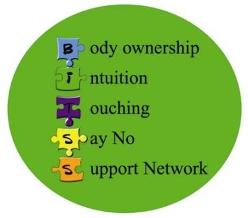
Australian Social Worker, Megan Bayliss, designed another widely accepted personal safety program: the BITSS model of Protective Behaviors. The model deals only with protecting against sexual abuse and focuses on protective play around,

B Body Ownership

I Intuition

T Touch

S Say No

S Support Network.

The central tenet of the BITSS model is to capture teachable moments during everyday play. It is not a classroom based program, rather, parents are encouraged to learn how to use everyday play resources to act as triggers for protective learning and practice around each of the BITSS elements.

Protective Behaviors help to keep our children safe. However, it is not a child’s responsibility to prevent child abuse. The responsibility lies with the abuser. If a child is sexually abused after receiving training in protective behaviors, it is not their fault nor does it mean the child did not learn anything. Sexual Abuse is always the fault of the predator.

Help keep our children safe. Teach some protective behaviors today and act protectively by telling someone if you suspect abuse of a child.


What's happening in your town at the moment to help protect our most valuable and sustainable resource: our children?


Which businessses are showing the most support? Let us know so that we can support them too.

Imaginif…You Knew How BITSS of Protective Behaviors Began.

After 15 years of working with families and children in both Australia and the U.K, across all levels of Government and in the community and private sectors, Megan Bayliss was sick and tired of waiting for business to make protective behaviors their business.

Megan embarked on a family focused business path of resource development. The original idea was to create and make available a number of specific resources that were easy to obtain, affordable and met best practice guidelines for working with children. Throughout this journey, market research continually supported that workers and parents were unable to identify specific elements of any protective behaviour programs.

With this low-level community knowledge in mind, Megan began to develop a model that would make it easy for parents, and workers, to remember how to fit protective behaviours together. Hence, a family friendly model of protective play resulted in the BITSS model of Protective Behaviors. BITSS is an easy to remember acronym for the important protective behaviour building blocks that are common to all other programs: the BITSS to remember are – Body ownership, Intuition, Touch, Say no, Support network. Since development, the model has grown to include in home protective play tutorials for parents/grandparents, easy read tutorials to support protective play, a series of children’s chapter books and workshops for people working with families and children.

How do you teach protective behaviors to your children?

What does your business do to support ending child abuse?

Welcome. Imaginif…you knew who we were.

Hello. Come on in and have a virtual coffee with us.

Imaginif is a privately owned Protective Behavior company that aims not only to protect children from abuse but also to give a voice to those who have survived child abuse.

There are three of us posting blogs around the business of protective behaviors: Megan Bayliss, Paul Martin and Jade Pinto. We each have a different area of professional expertise in the area of preventing child abuse and we each have an active part to play in making child protection important business.

Talking about child abuse is scary. The topic remains hidden under the covers and many parents prefer not to raise it with their children because of a fear they will damage their children’s innocence.

We want YOU. We want parents, grandparents, aunts, uncles, the business sector, and the survivors to help give a global voice to ending child abuse.

Child abuse is BIG business and big business needs big leaders willing to make child abuse prevention a BIG priority. YOU are that big leader.

Join us daily for a coffee and a chat. Share you stories, your ideas, your passion and most importantly, your POWER. Help us positively market the strength and vision that many survivors of child abuse have as their gift.

Blow the cover on child abuse. Talk, talk, talk and show the business community how beneficial it will be for them to support ending child abuse.

Imaginif means business. Protecting against child abuse is our business.

 
powered by Blogger