Wedding shopping (only 6 weeks to go) has turned up a few specials in child protection. Whilst researching and seeking best value wedding paraphernalia I have had many opportunities to enter into social chitchat. “What do you do for a living,” is the standard salesperson question while they attempt to assess what rage of product to display us. My partner’s occupation is totally acceptable and valued: an Accountant. My response, “sexual assault therapist,” is met mostly with two responses: sympathy and down cast eyes or total disdain.
Disdain wins no favors from me. There is no way I will part with my money in that store. Sympathy and down cast eyes really gets me going!!!! The hushed conversation generally runs along the lines of, “What a horrible job. It must be very sad, very hard and isn’t it terrible that some children are sexually abused. Surely it doesn’t happen here though.”
Not being one to overlook an opportunity to consciousness raise around sexual assault prevention, I take the opportunity to gently educate.
I love my job and I love the people I have the privilege to work with. People who are living with having been violated in the worse possible sense are generally amazingly strong, creative and loyal. Read the posts from abyss2hope: (A rape survivor's zigzag journey into the open), Sadly Normal (Seeking Justice and Support for Survivors of Child Sexual Assault), or Child Abuse Survivor (About a male survivor of childhood abuse, and the issues he faces in adult life) and I dare you to not find strength and conviction in these writers.
Those retail salespeople who allow disdain to prejudice their thoughts around sexual abuse have some lessons to learn. Remember that one in three adults report having been sexually abused as children. Their loyalty to your product and corporate responsibility lies untapped. Rarely have I seen businesses that openly support the plight of those sexually abused. Rarely have I heard from clients that they support business because business supports sexual abuse prevention. I can’t help but wonder on the untapped market of securing a loyal customer base of one in three people affected by sexual violence.
Many parents have openly displayed disdain toward talking to their children about protective behaviours. The possibility of child sexual abuse remains low in their thinking and daily lives. Fear of scaring their children or spoiling innocence are reasons frequently trotted out in discussions. Worse still, is embarrassment. Parents have told me that they don’t know how to talk about such a “rare” and “rude” topic.
This last point amazes me. Collectively, parents appear to have no difficulty seeking worm medicine or teaching young children how to wipe themselves when potty training. Both of these health issues centre upon those private nether regions that also do not make for acceptable dinner party talk. Yet, manufacturers and retailers draw enormous loyalty and profit from a customer base prepared to enter into public counter discussion about those little white squiggly threads in Jenny’s pooh.
Next time I’m met with disdain after disclosing my profession and passion, I’m not going to let them worm their way out of not recognising the value of child abuse prevention. In considering whether or not to spend my dollars in the store, I'll weigh up the wider corporate consciousness. The sales person may not give a toss as to if they make the sale or not, the owners probably do. Further, displays of sympathy will be challenged to become displays of action. You can bet your bottom dollar the store owners and staff will be looking for sympathy if I and people like me assess their corporate consciousness as unworthy of our retail spend. Child protection is a collective responsibility. If you feel sympathetic toward the case, do something to help prevent other children from being abused. This site is full of ideas on what you can do. It is often the smallest things that makes the biggest difference.
If you know of a business that does support the issue then they deserve recognition and public thanks. Leave a comment about them, I’ll check them out and dedicate a "Thumbs Up" post to them.
The Retail Value of Child Sexual Assault: Disdain or Sympathy?
2:04 pm
Megan Bayliss
Posted in
business,
child sexual abuse
Australia Week. G’day LA and NY
10:21 am
Megan Bayliss
Australian food, wine, fashion, film, arts, lifestyle, trade and investment, indigenous culture and tourism, the best of Australia says G’day. Promoting awareness and commercial return for both Australian and American interests, Australia Week 2007 sets up camp this week in Los Angeles and New York.
Steve Irwin (killed last September from a sting ray barb to the chest while furthering awareness of Australian marine life), the Croc Hunter, will be missed but honoured, and will receive a posthumous Lifetime Achievement Award, while Russell Crowe will receive an honour for his film achievements. A Family Day Concert caters to the Australian appetite of curious families in LA & NY. Australia’s favourite daughter in-law and granddaughter, Terri and Bindi Irwin (Australia Zoo), take to the stage with the Crocmen, and The Wiggles! Bindi Irwin is fastly becoming the face of Australian tourism and what a great job that little Aussie girl is doing.
The Great Aussie Auction, boasting more than 50 Australian holiday experiences is open for you to bid on an Aussie family holiday NOW. With a range of specially designed, unique Australian vacation experience, priced for auction from only $1, get in now and make your dream of an outback Aussie holiday closer to reality that you may have once thought.
Australia Week: G’day LA and NY. Don’t miss out. Check out the program of events to find out which taste of Australia is coming to a place near you.
Some other famous Australians furthering the plight of abused children (please add their names and links in comments so that we have a full and comprehensive list):
Pat Rafter (Tennis): Cherish the Children Foundation
Nicole Kidman (Actress): UNICEF ambassodor.
Shane Warne (Cricket): The Shane Warne Foundation
Geoffrey Rush (Actor): Silent Emergencies Appeal, UNICEF
Ian Thorpe (Swimming): Fountain for Youth.
UPDATE 20.1.06: Bindi Irwin wins them over with her impassioned vow about following her Daddy's work as a Wildlife Warrior. See news story at Bindi, Terri Irwin charm reporters.
Posted in
business,
famous people
Business is Protection. Moving Here.
9:54 am
Megan Bayliss
Business is Protection (A site about all business protection issues, including how business can help protect children) is being deleted. My partner, an accountant with a strong social justice principal, intended to write articles focused on business protection from a corporate social responsibility view point. Corporate life took over and unable to find time to write articles, we have decided to close his blog site down.
Corporate Social Responsibility is already one of Child Protection: Serious Business' focus areas so I am moving the only entries from Business is Protection here.
The Business of Waiting (2)
In defense of Paul Martin: he is in the business of life. An accountant, a business consultant, Imaginif book keeper, a loving partner and a step father to four, he is somewhat busy at the moment. While waiting for a corporate life pause that will allow Paul to write regular business protection articles, I thought I might as well link to business articles that I have already posted at Helium. I appreciate that my articles are no where near as good as his most excellent musings, but they are nonetheless an attempt at getting him to mind my business by providing protective business pieces that I just cannot measure up to.
This is my second Helium article:
Business plan: Staying true to your vision
Megan
The Business of Waiting (1).
While waiting for a corporate pause that will allow Paul to write his business articles, I thought I might as well link to a business article that I have already written at Helium.
Finding a company to buy your business ideas.
Posted in
business
Sexual abuse: Secret Business Must End.
2:40 pm
Megan Bayliss
There's no such thing as a good secret. Surprises are the best because secrets can only make you all scrambled up inside your head. Why would you want to know something that nobody else can know?
Too many sexual predators tell children to keep the little love games a secret. Confused, and fooled by the romantic notions of secrecy (Christmas, birthdays, etc) that we innocently fill our children's head with, children are often unable to tell a trusting adult the horrible secret inside their head.
Many people use the distinction of good secrets and bad secrets. This is a difficult concept for young children to grasp. Until a child’s level of moral development rises to a stage where they can developmentally grasp the difference between abstract concepts, children will keep secrets.
Just like the rubbish, throw the word “secret” out of your vocabulary. Replace it with “surprise”. A surprise can he held in brain trust for a particular period. The surprise ends on a particular date and at a particular time. Everyone is happy and talks excitedly about the surprise.
Change “secret” to “surprise” by playing the following game and letting children know that it is never okay to keep secrets because when they stay in your head they make you feel all jumbled up. They get more scary and confused and we feel awful. Secrets must be broken. Telling someone, aloud, is the best way to stop secrets.
Play Surprises: this is similar to the old Chinese Whispers game (also called “secrets”); a game of messages that change, distort and sound nothing like the first message. You need a group of children. A positive message (e.g., I love chocolate fairy cakes) is whispered into the first child’s ear. That child then whispers the message into the next child’s ear and this continues passing to each child until the message is back to the beginning person. The first child then states, aloud, the message they have just received. It is generally quite different to the way it started. Say SURPRISE, SURPRISE. If a child asks to play the secret game again (as they do), correct them by saying, “It’s called surprises because you must never keep secrets.”
Playing this game prepares a child’s mind for changing the word “secrets” to “surprises” and assists children to remember to tell about bad secrets.
What are you going to do to help rid your family of the word “secret”? Make it your business, your priority, to encourage transparancy. It makes good business sense. Kids are our business platform and I want my business to have a solid foundation, not a secret, cannot share, shaky one.
Posted in
business,
child abuse,
secrecy,
sexual abuse
What are Protective Behaviors?
7:05 pm
Megan Bayliss
Most people use Protective Behaviors with children without realizing they are even doing it. Every time you put hat and shoes on a child, you are protecting them from sun and ground harm. Every time you tell a child not to get into a car with someone they do not know, you are beginning to protect that child. Every time you speak to your child about good touch/bad touch, you are helping to empower your child to know what to do if someone tries to touch them inappropriately.
Although there are many different ways to empower people to protect themselves, the most well known program in the world is The Protective Behavior Program. Designed in 1984 by American Social Worker, Peg Floundreu West, the program is widely used across the U.S.A, Australia and in the U.K.
The concepts, ideas, and strategies of the original Protective Behaviour Program are themed to help us all remember that:
1. We all have the right to feel safe all of the time, and
2. Nothing is so awful we can't talk to someone about it.
These two themes guide lesson plans around keeping yourself safe from harm. Although the Protective Behavior Program originally focused on protecting children from sexual abuse, the two themes now encompass community safety in a range of different settings and for a range of different safety needs.
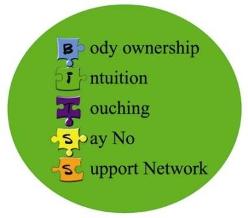
Australian Social Worker, Megan Bayliss, designed another widely accepted personal safety program: the BITSS model of Protective Behaviors. The model deals only with protecting against sexual abuse and focuses on protective play around,
B Body Ownership
I Intuition
T Touch
S Support Network.
The central tenet of the BITSS model is to capture teachable moments during everyday play. It is not a classroom based program, rather, parents are encouraged to learn how to use everyday play resources to act as triggers for protective learning and practice around each of the BITSS elements.
Help keep our children safe. Teach some protective behaviors today and act protectively by telling someone if you suspect abuse of a child.
Imaginif…You Knew How BITSS of Protective Behaviors Began.
6:03 pm
Megan Bayliss
After 15 years of working with families and children in both Australia and the U.K, across all levels of Government and in the community and private sectors, Megan Bayliss was sick and tired of waiting for business to make protective behaviors their business.
Megan embarked on a family focused business path of resource development. The original idea was to create and make available a number of specific resources that were easy to obtain, affordable and met best practice guidelines for working with children. Throughout this journey, market research continually supported that workers and parents were unable to identify specific elements of any protective behaviour programs.
With this low-level community knowledge in mind, Megan began to develop a model that would make it easy for parents, and workers, to remember how to fit protective behaviours together. Hence, a family friendly model of protective play resulted in the BITSS model of Protective Behaviors. BITSS is an easy to remember acronym for the important protective behaviour building blocks that are common to all other programs: the BITSS to remember are – Body ownership, Intuition, Touch, Say no, Support network. Since development, the model has grown to include in home protective play tutorials for parents/grandparents, easy read tutorials to support protective play, a series of children’s chapter books and workshops for people working with families and children.
How do you teach protective behaviors to your children?
What does your business do to support ending child abuse?
Posted in
BITSS,
business,
child abuse,
child safety,
children,
parenting,
protective behaviors,
protective behaviours
Welcome. Imaginif…you knew who we were.
3:54 pm
Megan Bayliss
Hello. Come on in and have a virtual coffee with us.
Imaginif is a privately owned Protective Behavior company that aims not only to protect children from abuse but also to give a voice to those who have survived child abuse.
There are three of us posting blogs around the business of protective behaviors: Megan Bayliss, Paul Martin and Jade Pinto. We each have a different area of professional expertise in the area of preventing child abuse and we each have an active part to play in making child protection important business.
Talking about child abuse is scary. The topic remains hidden under the covers and many parents prefer not to raise it with their children because of a fear they will damage their children’s innocence.
We want YOU. We want parents, grandparents, aunts, uncles, the business sector, and the survivors to help give a global voice to ending child abuse.
Child abuse is BIG business and big business needs big leaders willing to make child abuse prevention a BIG priority. YOU are that big leader.
Join us daily for a coffee and a chat. Share you stories, your ideas, your passion and most importantly, your POWER. Help us positively market the strength and vision that many survivors of child abuse have as their gift.
Blow the cover on child abuse. Talk, talk, talk and show the business community how beneficial it will be for them to support ending child abuse.
Imaginif means business. Protecting against child abuse is our business.