Imaginif prompts for daily writers.
If you wish to join the Writers Prompt Daily simply use the below photo (changes daily) as a prompt and post a short story, poem or paragraph to your blog. Leave a comment and your link here so that all participants can come to you and read/comment/encourage. Stories below are copyright and are Megan Bayliss' writing around the below daily picture prompt.


Showing posts with label child safety. Show all posts

Imaginif's New Website: www.imaginif.com.au

Imaginif…child protection became serious business.

Imaginif…there was a single place where 24 hour global conversation led to raising consciousness around child safety issues.
Imaginif… www.imaginif.com.au

Yes, we are now live and bringing a global child safety
conversation to your home computer.

Our aim: To become the largest on-line child protection conversation
in the world
.

Join several writers from around the world, a host of concerned parents, professionals and agencies, in our quest to put safety of children
uppermost in people’s minds.

We cannot reach our aim without YOU.

Join us at
www.imaginif.com.au.

FREE gift on registration in the forum

Protect Children from Poisons in the Home

Child safety involves protecting children from all potential harms. While many parents think that home is the safest place for a child to be, home also provides a poisonous mix of hazards that impact upon our children's safety.


Most adults know and accept the risks taken with medicines, drugs, cleaning products and pesticides but children do not. Poison safety in the home requires not only keeping poisons out of reach but also education around why things are poisonous.

About: Pediatrics offers a Poison Safety checklist designed to find unsafe areas in the home. An assessment of storage, accessibility and general child safety principles, it is an excellent start point for keeping kids safe from accidental poison and age appropriate curiosity. What it does not do is help parents educate children about why products must be kept out of reach.

Look for teachable moments to educate children about poison safety. Weaving poison safety and poison rules into general conversation is an effective way to help children retain information rather than the children thinking they are receiving a Mum and Dad lecture. Lectures frequently result in children zoning out and offering platitudes to trick their parent into thinking that full attention is being given.

A teachable moment may present at any time. Are you ready for it? Now that we are home schooling, our child has been exposed to unusual activities and routines that used to happen during his school attendance hours. Oven and bathroom cleaning provided teachable moments that I had not previously considered.

While helping me, child was asked to leave the room on several occasions. The fumes and toxins from two particular products left his eyes watering and nose complaining. In the interests of child safety and environmental protection, it is time to swap to green products.

So interested was child in the powerful effect of the cleaners that we spent some time outside talking about why poisons work, why they are poisonous and what to do if someone is overcome by the poison. This discussion led into the potent effects of mixing not only chemicals but also food products, medicines and alcohol, and accidental usage of the wrong product. Although I appreciate that Pop will be embarrassed, I also shared a family based poison mishap because the teaching opportunity was too great to ignore..

Pop made a mistake recently when barbecuing steak. Eyesight failing, Pop relies on things being put away in their correct space. Reaching for the green bottle of oil spray, Pop unknowingly grabbed the green Pesticide spray - put there by a guest who was helping to tidy up. It wasn't until he sprayed the steak that the smell told him it was Mortein. If Pop had been unable to smell, he would have served the steak and inadvertently poisoned his guests.

Child helped me to do a poison safety check. Within our kitchen alone, we found three bottles of hazardous chemicals that were within arms reach of visiting children. Further, we found four potentially hazardous poisons in the food pantry. Relocating all the products to a high spot, completely separate to the pantry, child and I decided to do a future home school project on poisonous foods and plants.

Our cleaning day turned into teachable moments of poisons information that may have been otherwise overlooked. While we know the importance of poison safety, children do not. Find a teachable moment and help keep your kids safe from poisons in the home.

Photo of "Poison" compliments of Hberends at stock.xchng

Imaginif...Child Protection Became Serious Business

Imaginif is set to launch our new protective behaviour concept: the largest on-line child protection conversation in the world. The new site (www.imaginif.com.au, not yet unveiled) will include child safety focused blogs by several writers and a forum to discuss all child safety related issues. The site knows no boundaries and will be open to people world wide: Mums, Dads, professionals, grandparents, kids over 16. Anyone can comment on blogs but forum participation requires becoming a member (free gift with sign up).

Largest on-line child protection conversation topics will include, but not be limited to:
  • Water, sun, farm, poison, snow and road safety (each is a separate category).
  • Child sexual assault prevention.
  • Healthy and safe food for kids. WRITERS NEEDED
  • Travel safety. WRITERS NEEDED
  • Internet Safety. WRITERS NEEDED
  • Gang safety. WRITER NEEDED
  • Bully safety. WRITER NEEDED
  • Teenage and dating safety. WRITERS NEEDED
  • Domestic violence safety. WRITER NEEDED
  • Business protection and safety.
  • Assist dogs for children with a disability. WRITER NEEDED
  • Covert child photography safety. WRITER NEEDED
  • Foster care kid safety. WRITER NEEDED
To reach our aim of being the largest child protection conversation in the world, we need more voluntary writers from around the world who are willing to commit to just one child safety focused blog per week, answer comments on their blog and participate (at least once per week) in associated discussions in the child safety forums. If child safety is a passion of yours, then we want you.

Interested? Apply today. Applicant writers will demonstrate specific knowledge in their nominated area of child safety (yes, caring parents qualify), will send a bio, three samples of their writing, two email referees and be willing to interact with Imaginif, via email or phone, if accepted.

This is a voluntary position and your weekly commitment would be for a minimum three months. You may be able to do it as part of your Corporate Social Responsibility if you are staff of a progressive and socially responsible company. Alternatively, you may be like me and consider child safety so important that you are willing to write for the passion of it. Others may choose to do it for personal reasons between themselves and their God - acting out their beliefs of helping other people.

Blogs will contain a short bio of the blogger at the end of each blog with a link to either bloggers own site or place of business. In text linking back to own business, other articles or industry specific sites is encouraged. What a great way to increase traffic to your site.

Bloggers who have English as a second language are welcome to send duplicate posts: one in English and one in their mother tongue. Publishing both ensures that people who don’t speak English can still become part of the largest on-line child protection conversation in the world.

Volunteer writers will retain copyright of their material but please respect that once posted it should not be posted word for word elsewhere.
The new global conversation on child protection will be monetized with Google AdSense and financial sponsor logos. This is required to meet hosting and site upkeep fees. Imaginif chooses to work independently without any government funding and supports the site from our other business income (sale of protective behaviour resources and consulting).

Should you be accepted as a blogger, your individual/company’s banner/logo can be included on the front page at no financial cost.

Apart from our impending start (in three weeks), there is no time frame on application for these short term and part time voluntary jobs. Writers will come and go. Please send this to people you may think will be interested.

For more information, contact me at imaginif@bigpond.com.au. I’m looking forward to entering into the largest on-line child protection conversation in the world with you.

Imaginif...child protection became serious business. Imaginif...you were part of the push.

Bibliotherapy: Using Books to Help Children Solve Problems.

Writing to right the ills against children, my chosen genre is children’s fiction: bibliotherapy. The use of a story to assist a child in grappling with and integrating social issues is a method I use successfully with children in counseling, and as a Mum of four, my kids have learnt how to solve problems through my choice of books provided them. Read here what Best Children’s Books says about bibliotherapy: the use of books to help children experiencing difficult times.

Parents frequently present as scared and unsure how to educate their children about personal safety: Scared that they may spoil their children’s innocence by discussing unpalatable things. Children’s innocence is spoilt by the perpetrating predators that seek our children out and destroy their self-esteem through bullying, violence and child abuse (physical, emotional, sexual and neglect).


One of my short children’s stories, Looking for Laughter, has been picked up by Pearson Education Australia and published in Challenge Magazine. The short story is about surviving school bullying by seeking out a laughter friend, another bullied child who can help turn the isolation and abuse into deep survival, using humor rather than fight back.

"I've been looking for laughter for a long time but it sure hid from me. All the girls hated me and I still hate them. Nobody would ever play with me and the teachers did mean things, all day. I wanted to run away, until I met Larry. I wasn't even looking for laughter on that day but there it was, right under my snotty nose. This is the story of the weird day that I wasn't looking for laughter but instead met Larry."

Child survival and personal safety is best encouraged by preparing our children for situations prior to them occurring. Books are a wonderful way for parents to gently introduce coping strategies and social understanding.

Read your child a book today and help prepare them for the unknown tomorrow.


Here’s my junior fiction book about body ownership (Bitss of Caramel Marmalade on Toast), chapter by chapter. It’s free for you to print and read rather than having to pay the $15.00 RRP.

Wedded to a Culture of Child Safety

Our wedding in the rainforest photos were delivered last night. We discussed how much the photographer had enjoyed the differences in the wedding style: the kids, the activities, the total inclusion and participation of guests.

Photographer referred to it as “a true social justice Megan and Paul style wedding.’ It was. We did what suited us and not what preconceived and traditional ideas of weddings commanded. Of major interest to me though was the photographers questions around what motivated us to include so many fantastic activities for children.

Including and caring for children is a culture: a mind set that ensures children’s needs, rights and safety stay uppermost on adult agendas. Many people struggle with this. Often, children are viewed as unimportant, silly or painful.

Pondering this, I can only imagine this thinking as based in models of individual and consumer driven power. Children do not earn money so therefore cannot spend it. Children do not have the vote so therefore cannot influence public and social policy. Children do not have the cognitive or emotional capacity to have a strong voice so therefore cannot use their words to change things. Children will do as they are told and will understand that what we do is best for them.

What happened to my four children? Strong, opinionated, intelligent and passionate, my children have grown into a culture that recognises the worth, the power and the voice of children. If children are not consulted and listened to, then something is amiss.

My children are leaders because I have empowered them and kept them safe every step of the way. Our culture of child safety was not fear based, it grew from an inherent belief that children are human beings with unique views, needs and requirements. I was never scared that bad things would happen to my children and therefore had to lock them up, keep them away from life’s evils. Instead, I understood that safety was a child’s right and that the rest of the adult world needed to change.

Children at the centre of our wedding was a natural progression for us. Our motivation was not forced, but rather, based on our strong belief that children matter. This is the culture that I hope is contagious.

Photo 1 is of my husband singing a wedding speech (Lady Bug's Picnic) with one of our guests.


Below photo is my wedding party: my children.

Magnets are Attracting Danger (CPSC Media Release)

NEWS from CPSC
U.S. Consumer Product Safety Commission
Office of Information and Public Affairs Washington, DC 20207

FOR IMMEDIATE RELEASE
April 19, 2007
Release #07-163

CPSC Hotline: (800) 638-2772, CPSC Media Contact: (301) 504-7908

Small Magnets Are Injuring Children

CPSC Releases Stronger Warning to Parents

WASHINGTON, D.C. As the number of toys with magnets increases, so is the number of serious injuries to children. The U.S. Consumer Product Safety Commission (CPSC) is aware of hundreds of complaints that magnets have fallen out of various toys and at least 33 cases where children swallowed loose magnets and required emergency surgery. In addition, a 20-month-old boy from Seattle, Wash. died.

Of the 33 cases, the children ranged in age from 10 months to 11 years, the majority were older than three, and the majority were boys. All of the injuries led to hospital stays, which ranged from three to 19 days. In nearly all cases reviewed by CPSC, children had suffered intestinal perforations.

In addition to the intestinal injuries from swallowing loose magnets, the CPSC is aware of one case of intestinal perforation after a child swallowed magnetic jewelry that was being worn on the child’s tongue, two cases of intestinal perforations after children swallowed complete components of building sets containing magnets, one aspiration of a loose magnet, and one perforation of the nasal wall from nose jewelry.

Within the past year, the CPSC has conducted five recalls with more than eight million products containing magnets that could come loose and fall out of the product. In the fall of 2006, the CPSC alerted parents to the emerging hazard of magnets. Even so, children continue to be treated in emergency rooms across the country for complications due to ingesting magnets or toy components with magnets.

If two or more magnets, two or more magnet components, or a magnet and another metal object are swallowed separately, they can attract to one another through intestinal walls. When this happens, parents and physicians may think that the materials will pass through the child. But with magnets this is often not the case. The magnets become trapped in the body and can twist or pinch the intestine, causing holes, blockage and infection in the intestine or blood poisoning. All of which can lead to death.

The CPSC is working with manufacturers, the toy industry and other stakeholders to protect children from the dangers of magnets. New voluntary standards requirements were approved on March 15th. In addition, the voluntary standards group will continue to consider additional requirements during the next year.

In the meantime, the CPSC is working to help those in the medical community better understand the hazard and how to properly diagnose it.

To help prevent serious magnet ingestion injuries the CPSC recommends:

  • Seek prompt medical attention if you suspect your child may have swallowed a magnet
  • Look for non-specific abdominal symptoms: abdominal pains, nausea, vomiting and diarrhea
  • Note that objects in x-rays may appear as a single object that could actually be multiple magnetic pieces separated by trapped intestinal walls
  • Keep small magnets and small pieces containing magnets away from young children who might mistakenly or intentionally swallow them
  • Look out for loose magnetic pieces – regularly inspect toys and children’s play areas for missing or dislodged magnets

CPSC has also prepared a safety alert on the hazard posed by small magnets.

Send the link for this page to a friend! The U.S. Consumer Product Safety Commission is charged with protecting the public from unreasonable risks of serious injury or death from more than 15,000 types of consumer products under the agency's jurisdiction. Deaths, injuries and property damage from consumer product incidents cost the nation more than $700 billion annually. The CPSC is committed to protecting consumers and families from products that pose a fire, electrical, chemical, or mechanical hazard or can injure children. The CPSC's work to ensure the safety of consumer products - such as toys, cribs, power tools, cigarette lighters, and household chemicals - contributed significantly to the 30 percent decline in the rate of deaths and injuries associated with consumer products over the past 30 years.

To report a dangerous product or a product-related injury, call CPSC's hotline at (800) 638-2772 or CPSC's teletypewriter at (800) 638-8270, or visit CPSC's web site at www.cpsc.gov/talk.html. To join a CPSC email subscription list, please go to www.cpsc.gov/cpsclist.asp. Consumers can obtain this release and recall information at CPSC's Web site at www.cpsc.gov.

Children at Weddings: Acceptable or Non-Acceptable?

WINNER of the GNMParents


Our home is a full on wedding planner battle zone. We are getting married this month in destination Rainforest, below a magnificent waterfall (pictured).

The wedding is a child-focused event (I have four children plus two now out of care, foster children). My eleven year old is best man and in charge of the Laser Tag Buck’s party. He is also responsible for dispersing the numerous varieties of glow sticks, bracelets, and necklaces while the adults sit and sing around a huge bonfire. My eldest daughter is giving her stepfather away and my eldest son is giving me away. The six children will be standing up with my partner and I – my partner is marrying a family, not just me.

Following the wedding picnic lunch and while adults are toasting with champagne, making speeches and being thoroughly boring in their adult kind of way, fully supervised activities for the kids include archery, a wet slip and slide and a flying fox. We have karaoke and a DVD organised for later in the evening following a BBQ tea.

Children are important to me and I cannot imagine not having a family focused wedding with a major concentration on children. However, some interesting child protection concerns have arisen surrounding having children at weddings.

We wanted to have corroboree (Australian Aboriginal story telling dance) but the dance troupe of my choice said that they don’t take their children dancers to weddings because of the risk of exposing the children to excessive alcohol consumption, fights and abuse. Fair point and one that I had not previously considered.

Many of our friends have also stated that they won’t be bringing their children to our wedding in the rainforest. Their reasons were mixed (some alcohol consumption related) but most stated that they cannot conceive of attending a wedding with their own children. It is not that they dislike kids or have anything against other people taking children; they just don’t want to take their own because they’d like to relax and let their hair down.

We’re not changing our plans. We welcome children at our wedding and have designed the function to be safe, family friendly and enjoyable for both adults and children. This is not a new thing for us. When we launched my children’s book (Bitss of Caramel Marmalade on Toast) the entire launch was facilitated by children. I believe in children and I will always support child safety and developmentally appropriate functions.

With developmentally appropriate functions in mind, I am curious about your thoughts on children at weddings: Acceptable or non-acceptable?

Related Wedding article from my eleven year old son's site:


GNMParents said...
Congratulations this post has been nominated for a Hot Stuff Award at GNMParents (www.gnmparents.com)Voting closes Friday. Good Luck

Poll: Choose your Hot Stuff Winner

How to Attract Site Traffic to Child Protection or Sexual Abuse Blogs

Child protection and sexual abuse issues may not be matters of high priority for general blog browsers. The terms rank low as searchable key words and the existing blog sites appear to have few comments. I have long pondered the reasons for this.

Child abuse is a scarey topic for many parents and others may chose not to leave comments lest they be identified as survivors or parents of abused children. Other’s may think that they have nothing worthwhile to say (you’re wrong though – everyone has something worthwhile to say).

Increasing general knowledge and creating talk around child protection and sexual abuse can be encouraged by increasing the number of visitors to our blog sites. How though??

Blog carnivals appear to assist. Visits to this site increase by an average 66.66% when I submit an article to a carnival. In addition, the page views increase threefold and it appears that I then attract more repeat visits.

Increased blog traffic equates to consciousness raising around issues that affect our children. It does not equate to increased comments on blogs, but then, although nice, this is not the ultimate aim for child protection blog keepers.

Child protection and sexual assault bloggers mostly want to raise consciousness and they want to decrease the numbers of abuse. They also aim to provide helpful protective hints, tips and information to interested readers.

But…if only the initiated read their blogs, how is consciousness raised? We need to reach further afield and attract new readers.

Step 1: Reading and commenting on blogs outside of our area of passion is a must to be able to balance our views with views of the greater blog community populace. When we leave comments, the curious click onto our names to see what we write about. Bingo, an instant curious audience to child protection/sexual assault issues.

Step 2: Most important is submitting to carnivals outside of your comfort zone: Different readership, different way of thinking and hopefully new discussion around your chosen area of blogging.

I am now posting my child protection articles to many carnivals, the obvious and not so obvious. Submit your appropriate blogs to these ones for some new readership:

Think outside the square to attract new visitors to your blog on child protection or sexual abuse. Join the carnival.

For other helpful ideas about attracting new blog visitors and increasing regular readership, check out Darren Rowse articles at Problogger.

Photo courtsey of OmirOnia at stock.xchng

THE MUMMY TEST

I was out walking with my 4 year old daughter. She picked up something off the ground and started to put it in her mouth. I took the item away from her and I asked her not to do that.

"Why?" my daughter asked.

"Because it's been laying outside, you don't know where it's been, it's dirty and probably has germs" I replied.

At this point, my daughter looked at me with total admiration and asked, "Wow! How do you know all this stuff?"

"Uh," I was thinking quickly, "all mums know this stuff. It's on the Mummy Test. You have to know it, or they don't let you be a Mummy."

We walked along in silence for 2 or 3 minutes, but she was evidently pondering this new information.

"OH...I get it!" she beamed, "So if you don't pass the test you have to be the daddy."

"Exactly" I replied back with a big smile on my face and joy in my heart.

Source unknown. Came to me on email.

Virtual Global Taskforce Against On-Line Sexual Exploitation of Children

Do you worry about your kids playing on-line all the time? Many parents worry for different reasons: no exercise, staring at a screen all the time, impaired social skills, or personal safety.

On-line Safety is my biggest concern about my kids playing habits. Just as sexual predators groom our kids and adults around them in real life, so too do internet sexual predators. Chat rooms and on-line game messaging are perfect places for those sneaky predators to mask their true colours. Befriending our kids, predators may pose as a similar age, say they have similar interests and skillfully trick our kids into releasing personal information.

Children love to share photos of themselves and like to look at photos of other kids. This is a natural part of a child’s development. It provides our kids with a sense of identity and allows them to measure themselves against others from different countries.

If ever anyone online asks your child for a picture of themselves, be wary. Allow the request to set of the bells of Notre Dame in your head. However, unless you have an open talking relationship with your child and you know what they are visiting, which games they are playing and whom their on-line friends are, you may never have the opportunity to find out if they’ve been asked the photo question. Often the request may be innocent, but you have to check it out. Who wants a photo of their child shared across a pedophile network or posted on sites that were not given permission by you or your child to be posted on?

Yesterday I had a lengthy chat with an Australian Federal Officer from the Online Child Sex Exploitation Team Economic and Special Operations. I wanted to know the process for listing Imaginif’s new on-line child protection conversation with the team that monitors on-line activity for child sex predators and exploitive material. The Officer was so incredibly helpful and he provided me some supportive information about where and how to report any suspicious activity.

The Virtual Global Taskforce is a partnership between police forces from around the world working together to fight online child abuse. Along with offering advice, information and support to both adults and children to protect themselves against child sex abusers the site encourages on-line reporting of any inappropriate or illegal activity with or towards a child online.

Created in 2003, The Virtual Global Taskforce, is a direct response to lessons learned from investigations into on-line child abuse around the world. It is an international alliance of law enforcement agencies (Australia, U.S.A, U.K, Canada and Interpol) working together to make the Internet a safer place and it is staffed by specialist police officers and investigators. Once a report is generated, the report will go to straight to them. From there, the report is sent to the country of origin for immediate investigation.

Although I am not a supporter of doing things anonymously, I appreciate that many parents prefer to make anonymous reports. One of the many advantages of using the Virtual Global Taskforce is that you can make an anonymous report about any suspicious on-line sexualized behaviour toward your children.

Please, don’t hesitate to use this service if you are concerned about any on-line activity. Investigation and proof is not your responsibility. The global team are trained, professional and passionate. They are the ones tasked with investigating and sorting the innocent from the guilty. The rest of us share the responsibility of reporting exploitive behaviour toward children. Remember, Child Protection is everyone’s business.

Some other excellent sites for ensuring your child’s on-line safety:


Netalert (Australia)


Netsmartz (U.S.A)

Kid Proof Safety (Canada and U.S.A)

Cybertip (Canada)

Child Protection: A Job that Never Ends

The time of house protection for my adult children is upon us. Today we are off to Ingham to housesit for my son and daughter-in-law while they have a well-deserved break at Airlie Beach. We will not be back until Christmas Eve.

Child protection is a job that never ends. My son is 22 and I know I am going to do the whole mother thing as he and his wife drive away: drive safely, risk manage around situations, don’t walk alone, ring me if anything goes wrong.

While parental concern drives kids to distraction, parental concern also provides reminders that we all need to stay vigilant in every situation. Just as fences, windows, doors, walls and roof protect our house, it is a parents job to act protectively toward their children.

Children growing up in incestuous situations often do not have a parent looking out for their holistic welfare. The lies and manipulation required to keep child sexual abuse, or incest, a secret damage our children’s minds and create a confused dynamic of trust.

Hypervigilant through fear of being hurt, the child who has been sexually assaulted often scans the environment for danger but misses the danger when it pops up right under their nose. These are the children who could well benefit from constant, daily reminders that often bad things happen when we least expect them and that they often happen in what we may consider to be safe spaces.

When was the last time that you provided your child with safety reminders? Most parents engage in protective behaviours without even realising that they are doing it. Given that child sexual abuse is so prevalent it is time to make a conscious decision to do our utmost to keep ALL kids safe.

Do a protective behaviour audit. What words, games or messages do you give to your children to let them know that they can tell you about anything, that they can listen to their early warning signs and that it is okay to be rude to people and say no when other people are breaking the rules of protection, decency and appropriateness.

See you again on Christmas Eve. Stay safe and remember that nothing is so awful that you can’t talk to someone about it.


Related articles on the BITSS model of Protective Behaviours:


Peeping Toms are Voyeurs.

Our neighbors had a prowler last night. The mother of the female only household caught the prowler peering through the bedroom window of the teenage daughter. Mother yelled at him and sang out for the help of her neighbors. The prowler stayed. It took several attempts at calling for someone to ring the police before prowler got the hint that his behaviour was unacceptable.

Peeping Tom behavior is voyeurism. It is against the law. It is a form of sexual assault. Sexual abuse occurs on a continuum ranging from non-contact behaviors at one end (voyeurism, showing children pornography, and sexual comments) through to penetration by use of a penis, fingers or an object at the other end.

Many sexual predators escalate in their behaviors. Their excitement increases and their ability to delay their own twisted sexual gratification of a need for power decreases. Let us make no mistake here though. Sexual assault is not about sex. It is about power.

That the prowler was unaffected by being seen last night is a warning bell to me. Is his behavior at point of escalation? Has he been peering through that young girl’s window previously? Is he so unbothered by the threat of Police that he waits until last moment of departure? I do not know; I am not a sexual predator.

What I do know is that I am wild that people do these horrible things to children. Child safety is of the utmost importance to our sustainable future. Every thing that happens to our children affects our collective global future. If threats to child safety are on the rise then we are going to have a next generation of adults who make reactive choices based on their own childhood traumas.

Together we can end the sexual exploitation of our children. Ensuring our own children’s safety is paramount, to reach out and ensure the safety of a least one other child is a humane and socially responsible action. To care costs nothing. To not act protectively will cost us misery in our old age as we watch the unthinking decisions our once children make because they did not live in a world that valued them or their safety.

I will be wandering over to our neighbor today. I will let them know that we will be watching out for them. I will let them know that we care. I will let the girls know that we are a safe house and that if ever they need to run to us that they are not to hesitate. I will not whinge about how our community is not safe. I will instead be proactive in ensuring that other children in our neighborhood know that there are people willing to stand up for their basic human right to live a life free of abuse – including being safe from peeping Toms.

Child protection: serious business.
What would you do if you caught someone looking into your daughter's bedroom window?

Hine shines on sexual predator

Deputy Chief Magistrate Brian Hine (Brisbane, Queensland, Australia) has shone his spot light right into the eyes of an Indian tourist wanting to migrate to Australia. The tourist is charged, and refused bail, for allegedly sexually assaulting a young mother, walking in a Brisbane park with her children, and (the following day in the same park) a 15-year-old school girl. In addition to the sexual assaults, the 26 year old, male, Indian tourist allegedly pretended to be a police officer.

Magistrate Hine has taken a tough line on predatory sexual behaviour and I congratulate him. The indicators of future sexual risk are prevalent in the Brisbane based tourist’s reported behavior. Until our communities take a strong stand against sexual predators, sexual assaults will continue. To prey sexually on adults is horrific, but to prey on children is despicable, abhorrent and worthy of the most severe penalties.

If the Indian tourist is found guilty, I can only hope that his application for migration to Australia is not considered. Now…where can we send all the resident Australian sex offenders off to should they ever again offend? Oh, hang on, didn’t they send them all to Australia once upon a time? Is that why Australia was called a penal settlement?

Thank you Magistrate Hine. May other’s now follow your precedent.

Assessing Protective Capacity

Psychosocial assessments are an integral part of my job. I frequently receive calls from both practioners and students asking for assessment frameworks, particularly in relation to a family’s capacity to act protectively. Therefore, I offer my preferred model publicly for you to use.

Risk assessment: Capacity to protect is a risk assessment of a parent’s ability to keep their child safe. When assessing risk I use a four score system designed by my psychologist colleague, Nick Rayner. The system contains the elements of, Acknowledgement, Acceptance, Adjustment and Accommodation. The risk will contain measures of low, medium and high-risk areas. Risk factors within each of the four “A” elements will be either static (fixed) or dynamic (change over time).

Acknowledgement includes the parties being able to objectively view their familial patterns from an external viewpoint. If an entity is unable to acknowledge a difficulty within a situational context then this suggests not only a closed system but also an inability to affect the following elements within the four score assessment.


Acceptance often hinges on personality constructs and whether an entity operates within an internal or external locus of control. A closed system with an external locus of control has minimal chance of acceptance.

Adjustment refers to whether the entity can adjust to news of difference and if there is a capacity to affect change. Without appropriate infrastructure, external supports and measures of check, adjustment can be difficult and take lengthy periods.

Accommodation is the practice and capacity in action to the point where it becomes accommodated into daily life and cognitive structuring. In closed systems, separate entities are often socialized to accommodate to the dominant authority only. When this authority is challenged, the structure may further close in upon itself and strengthen the internal accommodation to the dominant voice.

The “how-to” of applying the above elements to situational contexts cannot be offered in a blog. It is the subject of supervision, best practice and experience. Be aware that any assessment and report you prepare often requires defending in court. Never make an assessment without backing it up with evidence-based practice and a full understanding of the assessment framework you have used.

Technorati Profile

Topical Whensday: When will children be visible?

UNICEF’s 2006 report on the State of the World's Children focuses on excluded and invisible children who have no access to essential services, protection and participation. The sad reality of many of the world’s children set me reflecting upon the visibility of children in my own town.

To walk into my house, there would be little doubt that children are a focus: that they are valued and highly visible. To walk down my street, many houses wear children’s toys as a sign of “Children live here.” My local shopping village however, does not make children visible. A trendy little spot, I was unable to find a single sign that suggested visibility of children, let only being a child friendly place.

Some months ago, I facilitated a Child Protection forum in a beautiful holiday spot called Port Douglas. A place of stunning natural beauty, diversity, and a playground for the rich and famous, local people were concerned about the hidden child protection issues. Proactive and dedicated, they looked for a way to raise the profile of their most precious resource: the town’s children.

One young psychologist aptly raised the question: Where are our children? A drive around the beautiful town confirmed for me that Port Douglas offered few external signs of being child friendly. It was almost as though children were invisible to visitors. While this does not mean that the children were being hidden, or abused, it reflects a value that children are not as important as the tourist dollar.

The more I have remained conscious of the external signs of community friendliness toward children, the more I have noticed that the friendliness occurs in pockets. It is almost as though business, development and tourism reject children unless there is a financial gain in catering to the needs of children.

Our children are not a commodity to be bought and sold. Our children are a more important natural resource than oil, water, gas or eco tourism. Our children are our sustainable future and have a leading role in helping us manage the other mentioned natural resources that are becoming endangered. We need our children. We need to protect them, to make them visible, to give them a voice.

Look around your community. What are the signs you see that make children visible? Are there well-serviced parks with trees and playground equipment? Children’s artwork proudly displayed on the sides of buses? Stores that cater for families with young children? Interactive display’s that help children retain new knowledge? The list is endless.

When will children be visible in our developed worlds: When we start looking for the signs of a child friendly community and take action to replace child unfriendliness with the high profile of children’s needs.

Other Topical Whensday blogs by Megan Bayliss:

Topical Whensday: When Will YOU Tee On to Cause an Effect?

Topical Whensday: When will YOU wear a Colored Tee to Recognize Violence Against Women and Children.

The business of protecting children.

Child protection is a community responsibility. Statutory bodies (aka "the welfare")are the pointy end of the stick. They come in after an act of child abuse occurs. The ideal situation is not to need child protection statutory bodies. If all community members took responsibility for placing child protection high on the daily agenda we may just reach the place of under working our child protection workers.

NAPCAN Australia works to encourage child friendly practice. They set challenges for individuals, communities and businesses. Eager to protect all kids and reduce the staggering claim that a child in Australia is abused every 13 minutes, I support their endeavors and loan them my full commitment.

Child friendly practice is, unbelievably, an area that many parents have told me they do not have time for. They wrongly think that they have to become radical, vocal and give up their day jobs. Child friendly practice is something we can all do without changing our lives or going back to University to learn theories, skills and mind twisting histories. Child friendly practice is an attitude that many already display without realizing what they are doing. Child friendly practice helps keep kids safe.

NAPCAN’s Child friendly Challenge for INDIVIDUALS advocates the following simple tips that EVERYONE can do easily and quickly:

1. Smile at a child - you were a child once

2. Let a parent with kids ahead of you in the queue

3. Donate your clothing, furniture or toys for use by another family

4. Cook a meal for parents with a newborn baby

5. Tell a child a story from your childhood

How easy is that? Take the Child Friendly Challenge today and let kids know that their business is our business because kids count.

Have you got any other simple child friendly tips that people can do to help protect kids?

What are Protective Behaviors?


Protective Behaviors are a set of sensible, down to earth behavioral response plans for personal safety. Protective Behaviors can cover personal safety in all sorts of situations: sun, road, water, poison, health, farm, fire and people safety. Learning about Protective Behaviors is a way of developing “how to respond” information and personal power. Protective Behaviors give people the skills they need to protect themselves from harm. Often used to protect children from sexual predators, Protective Behavior programs also empower the elderly, the sick, and buildings like schools or churches that are sometimes a target for vandalism.

Most people use Protective Behaviors with children without realizing they are even doing it. Every time you put hat and shoes on a child, you are protecting them from sun and ground harm. Every time you tell a child not to get into a car with someone they do not know, you are beginning to protect that child. Every time you speak to your child about good touch/bad touch, you are helping to empower your child to know what to do if someone tries to touch them inappropriately.

Although there are many different ways to empower people to protect themselves, the most well known program in the world is The Protective Behavior Program. Designed in 1984 by American Social Worker, Peg Floundreu West, the program is widely used across the U.S.A, Australia and in the U.K.

The concepts, ideas, and strategies of the original Protective Behaviour Program are themed to help us all remember that:

1. We all have the right to feel safe all of the time, and

2. Nothing is so awful we can't talk to someone about it.

These two themes guide lesson plans around keeping yourself safe from harm. Although the Protective Behavior Program originally focused on protecting children from sexual abuse, the two themes now encompass community safety in a range of different settings and for a range of different safety needs.

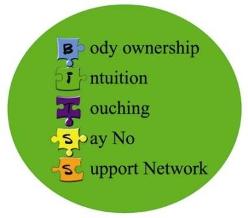
Australian Social Worker, Megan Bayliss, designed another widely accepted personal safety program: the BITSS model of Protective Behaviors. The model deals only with protecting against sexual abuse and focuses on protective play around,

B Body Ownership

I Intuition

T Touch

S Say No

S Support Network.

The central tenet of the BITSS model is to capture teachable moments during everyday play. It is not a classroom based program, rather, parents are encouraged to learn how to use everyday play resources to act as triggers for protective learning and practice around each of the BITSS elements.

Protective Behaviors help to keep our children safe. However, it is not a child’s responsibility to prevent child abuse. The responsibility lies with the abuser. If a child is sexually abused after receiving training in protective behaviors, it is not their fault nor does it mean the child did not learn anything. Sexual Abuse is always the fault of the predator.

Help keep our children safe. Teach some protective behaviors today and act protectively by telling someone if you suspect abuse of a child.


What's happening in your town at the moment to help protect our most valuable and sustainable resource: our children?


Which businessses are showing the most support? Let us know so that we can support them too.

Imaginif…You Knew How BITSS of Protective Behaviors Began.

After 15 years of working with families and children in both Australia and the U.K, across all levels of Government and in the community and private sectors, Megan Bayliss was sick and tired of waiting for business to make protective behaviors their business.

Megan embarked on a family focused business path of resource development. The original idea was to create and make available a number of specific resources that were easy to obtain, affordable and met best practice guidelines for working with children. Throughout this journey, market research continually supported that workers and parents were unable to identify specific elements of any protective behaviour programs.

With this low-level community knowledge in mind, Megan began to develop a model that would make it easy for parents, and workers, to remember how to fit protective behaviours together. Hence, a family friendly model of protective play resulted in the BITSS model of Protective Behaviors. BITSS is an easy to remember acronym for the important protective behaviour building blocks that are common to all other programs: the BITSS to remember are – Body ownership, Intuition, Touch, Say no, Support network. Since development, the model has grown to include in home protective play tutorials for parents/grandparents, easy read tutorials to support protective play, a series of children’s chapter books and workshops for people working with families and children.

How do you teach protective behaviors to your children?

What does your business do to support ending child abuse?

Welcome. Imaginif…you knew who we were.

Hello. Come on in and have a virtual coffee with us.

Imaginif is a privately owned Protective Behavior company that aims not only to protect children from abuse but also to give a voice to those who have survived child abuse.

There are three of us posting blogs around the business of protective behaviors: Megan Bayliss, Paul Martin and Jade Pinto. We each have a different area of professional expertise in the area of preventing child abuse and we each have an active part to play in making child protection important business.

Talking about child abuse is scary. The topic remains hidden under the covers and many parents prefer not to raise it with their children because of a fear they will damage their children’s innocence.

We want YOU. We want parents, grandparents, aunts, uncles, the business sector, and the survivors to help give a global voice to ending child abuse.

Child abuse is BIG business and big business needs big leaders willing to make child abuse prevention a BIG priority. YOU are that big leader.

Join us daily for a coffee and a chat. Share you stories, your ideas, your passion and most importantly, your POWER. Help us positively market the strength and vision that many survivors of child abuse have as their gift.

Blow the cover on child abuse. Talk, talk, talk and show the business community how beneficial it will be for them to support ending child abuse.

Imaginif means business. Protecting against child abuse is our business.

 
powered by Blogger